BZ’18–’45
THE EXTERIOR, THE RING
The writer Alessandro Leogrande wrote in his book La Frontiera exactly what we had in mind; “…the greatest intervention on the monument is not so much the exhibition path, but rather a LED ring that encircles one of the central columns. On the circular black screen, which is at least half a meter thick, the title of the exhibition (BZ’18–’45…) scrolls in red, translated into three languages: Italian, German, and English. Piacentini’s work has not been removed, but this sort of conspicuous ‘nose ring’ has the power to desacralize it, transforming it into something other than itself. Between the rhetoric of the monument and the eyes of those who observe it, a third element immediately insinuates itself, overturning its deeper meaning.”
THE INTERIOR
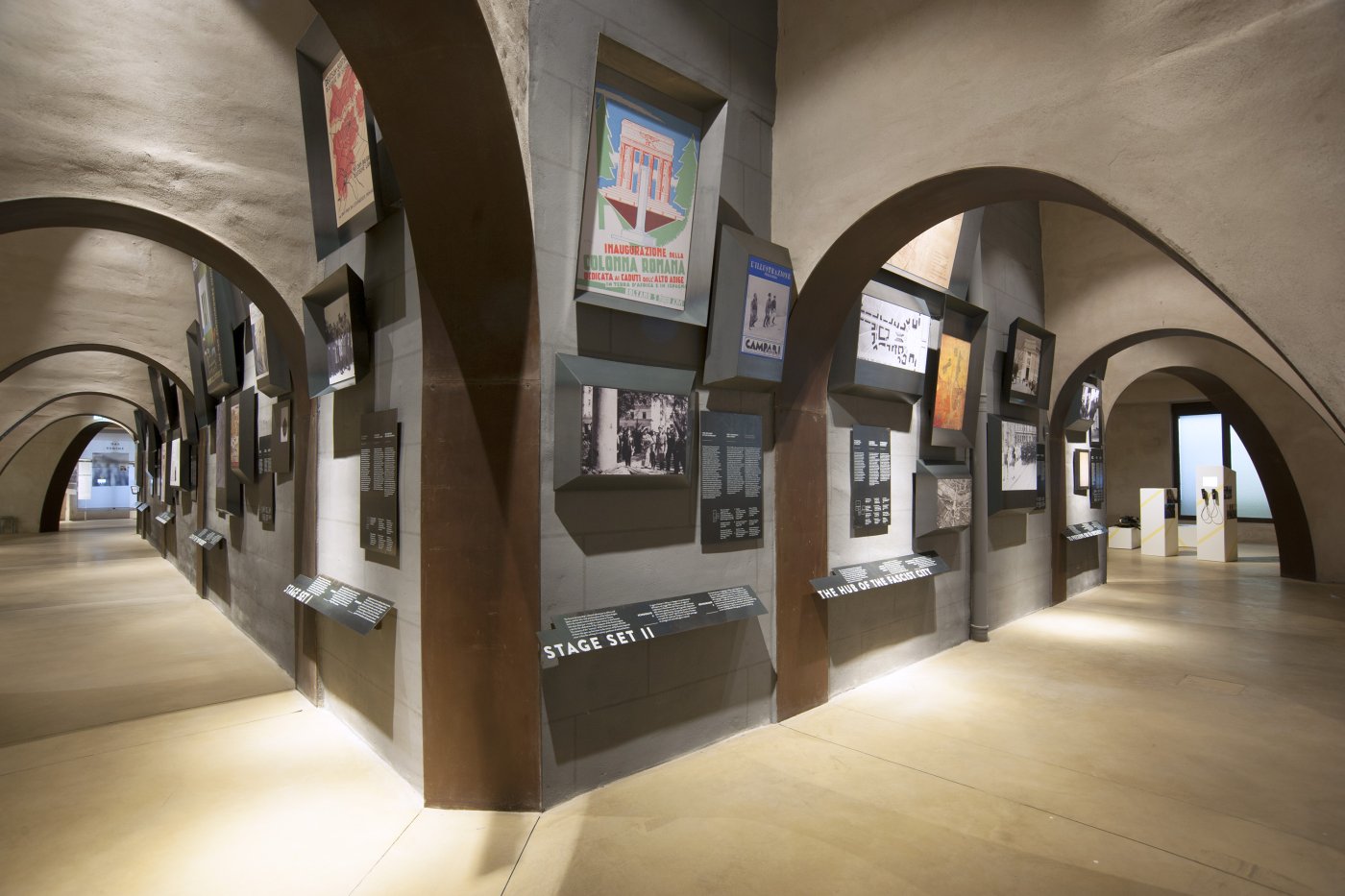
An installation with various scenographic interpretations – each theme has its own visual impact. THE ATRIUM AND THE CRYPT: The two entrance rooms are left bare and neutral, acting as intermediaries between the evocative exterior and the more documentary spaces that follow. Only a light intervention, a laser-engraved inscription, overlaps a fascist-era frieze. The artistic intervention of these 15 underground rooms evolves around the core (the crypt) in a counterclockwise direction.
What is a monument?
The four corner rooms discuss "monuments" in general. M-shaped furniture, which starts imposing in the first room, decomposes and deforms, transforming into a bench in the last room.
THE MONUMENT AND ITS HISTORY
The installation on the walls towards the interior works with the direct interpretation of the historical period of the monument itself – the microhistory. Black steel panels in the shape of rusticated masonry. Reproductions of significant images, photographs, and documents are displayed.
HISTORY AND TERRITORY
At the outer perimeter, galvanized steel beams extend beyond the walls. Democratic beams that symbolize various ideas, voices, and directions, upon which blurred large-scale photographs encourage closer exploration of the history of the two dictatorships, fascism and Nazism. Asymmetric glass panels resemble “shards of shattered histories.”